Most of the time I spend debugging SM2, SM3 or SM4 isn’t spent on the algorithm. It’s spent on the question around it: is this hex string the key or the IV, is that ciphertext C1C3C2 or something else, is this Base64 or hex, and does my output match the reference vector or not. To answer that today, you install a toolkit, find the right flags, and hope the defaults match the system you’re comparing against.
gm-crypto-web is my answer to that. It’s a page at frankxue.dev/gm-crypto-web where you can hash with SM3, encrypt and decrypt with SM4 (ECB and CBC), and generate keys, sign, verify, encrypt and decrypt with SM2, switching between hex and Base64. Nothing to install, nothing to configure.
The same code, compiled to WebAssembly
I didn’t want a second implementation. A debugging tool that disagrees
with the library it’s meant to help debug is worse than no tool. So the
page runs gm-crypto-rs itself: the gmcrypto-core crate at 1.16.0,
pinned to a fixed commit and compiled to WebAssembly through
wasm-bindgen. The release build is size-optimised with link-time
optimisation, but the arithmetic is the same arithmetic the crate ships.
That also settles where the computation happens. Everything runs in your browser. The tool has no backend or account and does not upload or persist the keys and messages you enter. It does save your language preference in localStorage. That describes this implementation, not a security guarantee.
A self-test that actually runs
The badge at the top of the page says the tool passes 11/11. I wanted that number to be earned every time, not typed once into the HTML. So on load the page quietly runs its self-test cases through the WebAssembly module and the badge reflects that run. The total comes from the case list in the code, not from the markup, and if the list and the results ever fall out of step the self-test throws instead of showing a pass.
SM3 and SM4 are checked against the GB/T test vectors. SM2 is checked by round trip: key derivation, sign and verify with the default or a custom ID, tampered message and wrong ID must fail, and encrypt then decrypt. A tool that only ever says “yes” hasn’t shown you anything.
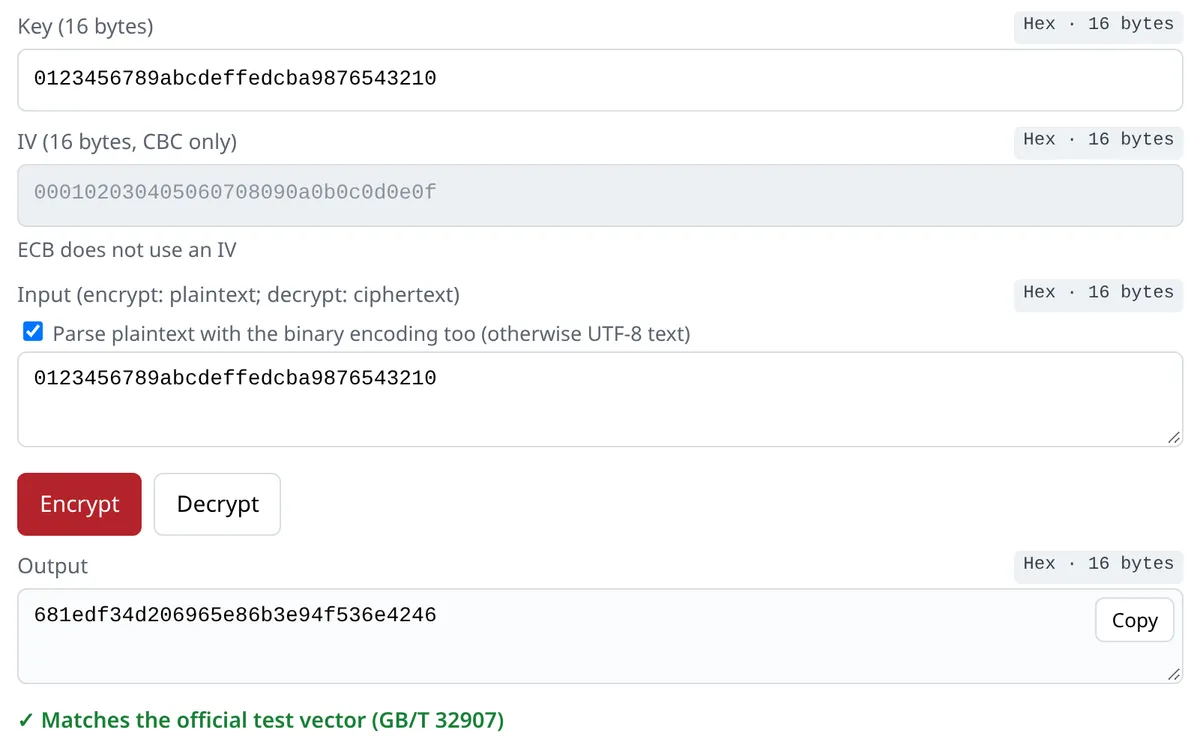
You can also run the self-test by hand and see each case’s result.
Honest limits
A few things I’d rather say out loud than leave implied.
It’s unaudited. It’s for learning, debugging and interoperability testing. Please don’t paste production keys into it, or into any web page.
Inputs have size limits. SM4 inputs are capped at 256 KB, and SM3 and SM2 inputs at 1 MB, measured in decoded bytes, with room for padding or ciphertext overhead when decrypting. The implementation records a development measurement of roughly 2.1 seconds per megabyte for SM4 in WebAssembly. The caps aim to keep actions responsive; they do not guarantee a one-second response on every device or browser. A debugging tool that freezes the tab isn’t helping anyone debug.
The scope is deliberately small. No X.509, no GCM, CCM or XTS. Those are real needs, but they’d turn a focused checker into a half-finished toolkit.
How I checked it
The page is tested with Playwright across Chromium, Firefox and WebKit,
on desktop and mobile viewports, in both English and Chinese. The scripts
live in the public repo’s pw/ folder. They load the page the way a visitor
would, drive the inputs, compare outputs against expected bytes, check
clipboard and error behaviour, and, in Chromium, watch for long tasks
when rejecting oversized inputs.
It’s not a substitute for an audit, and I don’t present it as one. What it does give me is a page whose claims I can re-check whenever I change something, the same discipline I try to keep in gm-crypto-rs itself.
If you work with the Chinese national standards and spend too long wondering whether the bytes are wrong or the format is, I hope it saves you that hour. Try it, and if it disagrees with a reference you trust, I’d like to know.